What is veranda? Pronunciation and usage in English

veranda means . Learn how to pronounce and use veranda through vivid examples and easy-to-understand exercises.

Definition & pronunciation of veranda

verandanoun

/vəˈrændə//vəˈrændə/
Definition & pronunciation of veranda

Okay, let's break down how to pronounce "veranda." It's a tricky one for English speakers! Here’s a breakdown:

The most common and accepted pronunciation is:

  • vur-AHN-dah

Let's break that down syllable by syllable:

  • vur: Like the "ver" in "verb" – a short, quick “uh” sound.
  • AHN: This is the key part! It rhymes with “man” or “fan.” The "a" is a long "a" sound – like in "father" or "car." It's a stressed syllable.
  • dah: Like the “dah” in “father.”

Here's a breakdown of the sounds:

  • v - as in "van"
  • e - as in "bed" (short "e" sound)
  • r - a quick tap of the tongue against the roof of your mouth (like in "red") – don’t roll your "r"
  • a - as in "father" (long "a" sound)
  • n - as in "no"
  • d - as in "dog"
  • a - as in "father" (long "a" sound)

Resources to help you hear it:

Tips for getting it right:

  • Stress: The second syllable ("AHN") is the stressed syllable. That means it’s the part you emphasize when you say the word.
  • Don’t “ver-en-da”: Many people accidentally pronounce it like “ver-en-da.” It’s the "ahn" that’s important.
  • Practice! Say it aloud several times, focusing on that long "a" in "AHN."

Would you like me to:

  • Repeat the pronunciation slowly?
  • Give you some example sentences using “veranda”?

Usage and examples with the word veranda in English

Let's break down how to use the word "veranda" correctly in English.

What is a Veranda?

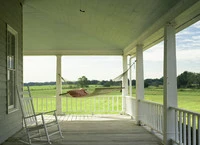
A veranda is a covered, open-air gallery or porch, usually attached to the exterior of a building. It’s typically found on the ground floor and offers an outdoor space that's sheltered from the elements. Think of it as a transitional space between the indoors and outdoors.

How to Use It – Grammatically and Contextually

  1. Noun Usage (Most Common): "Veranda" is almost always used as a noun.

    • Example: "We spent our evenings on the veranda, enjoying the sunset."
    • Example: "The veranda was decorated with potted plants and comfortable chairs."
    • Example: "The old house boasted a beautiful, wrap-around veranda."
  2. Plural Form: The plural is simply "verandas."

    • Example: "The estate featured three verandas, each with its own unique style."
  3. Descriptive Details: You can use “veranda” to describe specific aspects:

    • Wrap-around veranda: A veranda that extends completely around the side of a building.
    • Screened veranda: A veranda with screens to keep out insects.
    • Balcony veranda: A veranda that’s essentially a small balcony.
  4. Figurative Use (Less Common): Occasionally, "veranda" can be used metaphorically to describe a relaxed, enjoyable space or experience. This is less frequent and more stylistic.

    • Example: "His life had become a veranda – safe, comfortable, but lacking in excitement." (This is a more evocative, literary use.)

Tips for Using it Effectively:

  • Think “Porch” or “Balcony” (But More Formal): If you’re struggling, “porch” or “balcony” are good substitutes, but “veranda” carries a slightly more sophisticated and often historic connotation.
  • Context Matters: Verandas are most commonly associated with older homes, especially in Southern United States, the Caribbean, and parts of Europe. They’re also popular in vacation homes and resorts.

Here are some sentences showing how to use “veranda” in different contexts:

  • "The cool breeze flowing through the veranda was incredibly refreshing."
  • “She loved reading on the veranda in the afternoons.”
  • “The architect designed a spacious veranda for the master suite.”
  • “Let’s have a picnic on the veranda while the weather is nice.”

Resources for Further Learning:

Do you want me to:

  • Give you more examples of how to use it in a sentence?
  • Explain the historical significance of verandas?
  • Help you write a sentence using “veranda” in a specific context (like a description of a house)?

Practice with vocabulary veranda

Exercise 1: Fill in the blanks

  1. The colonial-era building featured an expansive ___________ that wrapped around two sides, offering a cool respite from the midday sun.
  2. During the break, conference attendees gravitated towards the large outdoor ___________ to continue their discussions and enjoy the panoramic city views.
  3. The modern apartment boasted a compact ___________, just wide enough for a small table and two chairs, providing a private outdoor space for residents.
  4. Our team frequently utilizes the open-air ___________ on the rooftop for informal meetings and collaborative brainstorming sessions, especially in good weather.

Exercise 2: Choose the correct answer

  1. Which of the following architectural features is typically an open, often roofed, gallery or portico attached to the outside of a building, extending along one or more sides? a) A pantry b) A veranda c) A cellar d) A mezzanine

  2. If you are asked to suggest a comfortable outdoor space for guests to relax with a drink while enjoying a scenic view at a hotel, which options would be most suitable? (Select all that apply) a) The attic b) The lobby c) The veranda d) The terrace e) The utility room

  3. What activities are commonly associated with using a veranda in a professional or social setting? (Select all that apply) a) Conducting private interviews in complete isolation. b) Holding informal networking events. c) Enjoying a meal or refreshments outdoors. d) Storing heavy equipment or machinery. e) Hosting a small, open-air presentation.

  4. A private, usually small, elevated platform attached to the exterior of an upper-floor apartment, often enclosed by a railing, is best described as a: a) Patio b) Balcony c) Deck d) Courtyard

  5. Which term describes a large, paved outdoor area, typically adjacent to a house or commercial building, used for dining, relaxation, or entertaining, and usually uncovered? a) A conservatory b) A gazebo c) A patio d) A solarium


Exercise 3: Rewrite the sentences

  1. Original: The old mansion had a long, covered outdoor area at the front where people could sit and observe the street below. Rewrite using "veranda":

  2. Original: We decided to move our afternoon tea party to the open-sided porch because the weather was so pleasant. Rewrite using "veranda":

  3. Original: The executive suite on the third floor features a small, private outdoor ledge where guests can enjoy fresh air. Rewrite using a suitable replacement word (not "veranda"):


Answer:

Exercise 1: Fill in the blanks

  1. The colonial-era building featured an expansive veranda that wrapped around two sides, offering a cool respite from the midday sun.
  2. During the break, conference attendees gravitated towards the large outdoor veranda to continue their discussions and enjoy the panoramic city views.
  3. The modern apartment boasted a compact balcony, just wide enough for a small table and two chairs, providing a private outdoor space for residents.
  4. Our team frequently utilizes the open-air terrace on the rooftop for informal meetings and collaborative brainstorming sessions, especially in good weather.

Exercise 2: Choose the correct answer

  1. b) A veranda
  2. c) The veranda, d) The terrace
  3. b) Holding informal networking events, c) Enjoying a meal or refreshments outdoors, e) Hosting a small, open-air presentation
  4. b) Balcony
  5. c) A patio

Exercise 3: Rewrite the sentences

  1. Rewrite using "veranda": The old mansion had a long veranda at the front where people could sit and observe the street below.
  2. Rewrite using "veranda": We decided to move our afternoon tea party to the veranda because the weather was so pleasant.
  3. Rewrite using a suitable replacement word (not "veranda"): The executive suite on the third floor features a small, private balcony where guests can enjoy fresh air.

Comment ()